1. In (3), it is written: "...individuals who use marijuana for long periods of time can develop a [psychological] dependence on it. Signs of [this] dependence in a user include the need to use marijuana to cope with everyday tasks and the experience of cravings and anxiety when marijuana is not available."
 |
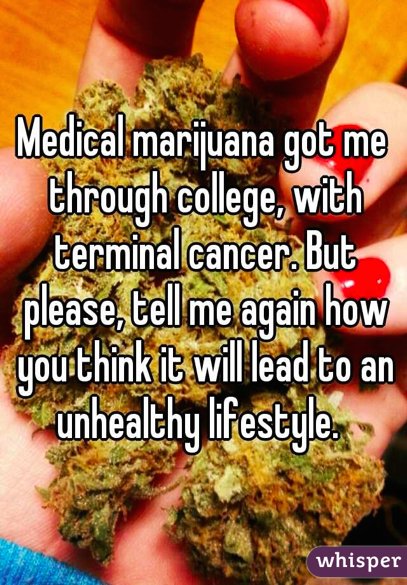
| This image represents the concept of dependence. |

Well, is this not good news? What if the term "weed" was replaced with "heroin"? There is absolutely no debate on heroin's harmful effects which always come before death. If pot is the most common illicit substance, doesn't that mean people are unaffected by death and able to continue using pot? Does this express that in spite of someone landing themselves in the hospital from greening out, they walk out of there quickly enough? This marijuana statistic combines recreational and medicinal use, one perhaps more than the other. A large amount of people want their right to consume cannabis for their individual purpose, which we can see in the percentage.
3. "A growing body of research suggests that... can negatively affect mental and physical health, brain function ..." (5)
 The reason I replaced the most of this sentence by dot dot dot is because I want to show something specific: "growing body of research". Where is it?! There is an obvious ambiguity in this statement. I hate limited clarifications and this is what's going on here. This must be due to the "research" needing to be negative. After quickly skimming through the remainder of the section, I was directed to a policy brief. I opened the link, and this point is open to argument in the comments, but a policy brief released from an organization supported by the government having BUT TEN PAGES OF INFORMATION, two of which are DEDICATED TO SOURCING, is pretty unusual. I can directly relate this to my theory, you know, the one you're tired of hearing about, the "research" theory. The fact that an organization similar to CCSA can talk in circles for eight pages with no problem is a extreme problem. This report, also, is being released from the Canadian Centre for Substance Abuse. ABUSE! Why couldn't Health Canada release this report? It must be since the government want to lead the population away from the truth. This is happening even though Health Canada is helping families through marijuana really discreetly. In their brief, there is a whole section dedicated to other countries, which means they are avoiding the subject.
 I'm so smart! (JK, JK. Lots of this is me going in circles in my head but if the government can do it, then so can I!)
In my opinion, my biased yet nonetheless my opinion, I believe that what is below this sentence, to the right of the picture, is the TRUTH.
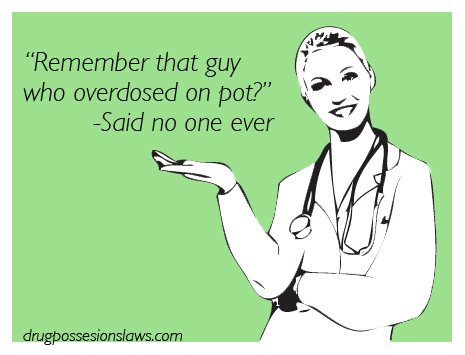
Maybe it'll show them that I'm crazy... moving on.

My personal inference, for the millionth time, is that the people who don't educate the public subconsciously admit more by doing exactly that. The government tried to somewhat reverse this through the legalization of medical cannabis, but I think they don't want the population to discover that there's no such thing as a marijuana overdose. The way they implement this strategy is by giving people on medical marijuana small quantities at a time and strictly enforcing this. Did anyone ever notice that? I DID. I am rather frustrated that everyone is unable to share my perspective. I have found multiple references and I can advocate from experience, which is the best teacher. The above should provide hope for those who find relief in marijuana. Currently, in Canada, cannabis possession can imprison someone for up to 5 years, production totals to 7 years, and trafficking, for life. (5) Consumers who have weed as their primary treatment are only scared. In a free country, this should not be an issue. Us citizens can work to resolve this for everyone in need.
(Apologies for the irregular switching of font size. I have tried to fix it but to no avail.)
(1) http://www.theweedblog.com/how-much-marijuana-does-it-take-for-someone-to-overdose/
(2) http://dangerousminds.net/comments/how_much_pot_would_it_take_to_kill_you
(3) http://drugabuse.com/library/marijuana-abuse/#effects-of-marijuana-abuse
(4) I know people/general online research.
(5) http://www.ccsa.ca/Eng/topics/Marijuana/Pages/default.aspx
(6) http://www.ccsa.ca/Resource%20Library/CCSA-Medical-Purposes-Marijuana-Policy-Brief-2015-en.pdf